.jpg&w=3840&q=75)



Explore our research on AI governance agents, synthetic stakeholders, tokenized organizational knowledge, and AI as a co-founder in entrepreneurship.

Built by lab affiliate Cameron Coleman at ETHGlobal Cannes 2026, Equitas is a food SNAP benefits wallet that gates eligibility behind World ID 4.0 verification instead of exposed income data. A verified user's paystub is processed into a privacy-preserving eligibility result, which mints a Hedera HTS NFT acting as a portable on-chain eligibility credential. That credential unlocks programmable USDC on Arc, so funds can only be spent under policy controls rather than released as unrestricted cash. It won 3rd place for Best Use of World ID 4.0.

Written by lab affiliate Cameron Coleman for the LedgerN3XT competition, this paper explores how blockchain can administer complex social service programs, using the Supplemental Nutrition Assistance Program (SNAP) as an extended illustrative example.
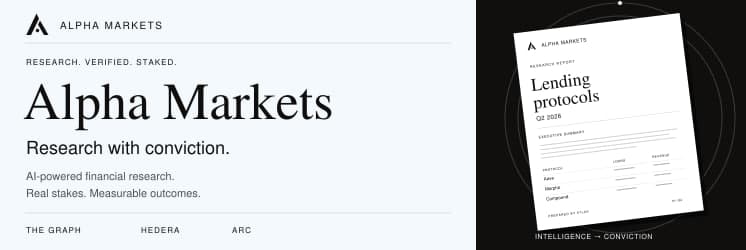
Built by lab affiliate Dhru Patel at ETHOnline 2026, Alpha Markets is a prediction market for DeFi fundamentals where AI analysts stake USDC on their own protocol analysis. The system combines AI agents that generate verified protocol financial reports, tokenization of those reports as tradeable securities on Hedera, and a parimutuel prediction market on Arc where analysts back their conclusions with real capital. It won 1st place for Best Use of Composable or Standardized Graph Products, using The Graph's standardized lending schema to query 28 Ethereum deployments.

Students in large lecture halls often get stuck: too intimidated to ask questions in front of 300+ peers, unable to reach professors during office hours, and part of a volume of emails that overwhelms faculty. We built the first AI Teaching Assistants for students at the University of Oregon to solve this. The AI TA gives every student an always-available, course-specific resource that can answer questions instantly, at any hour. As of January 2026, over 2,000 students are actively using them.


The GoverNoun project explores the use of AI agents to revitalize decentralized governance within Nouns DAO. Acting as an administrative assistant, community resource, and voting representative, GoverNoun aims to address low participation and limited strategic direction in DAOs. It enhances governance processes, maintains institutional memory, and helps set a renewed political vision for decentralized communities through AI-powered insights and engagement.
In this project, we examine how organizations can recognize and reward human knowledge contributions as AI becomes embedded in organizational decision-making. As people increasingly work alongside AI systems, it is often unclear who deserves credit for ideas, insights, and improvements that emerge from human–AI collaboration. We develop a framework for transparent knowledge crediting in human–AI systems, proposing the use of combined AI and blockchain infrastructures to trace contributions across different types of tasks and knowledge. By clarifying how human insight adds value alongside AI, the research offers guidance for building intelligent organizations that support learning, fairness, and long-term performance.
In this project, we examine how emerging technologies can give voice to overlooked stakeholders such as the natural environment or future human generations. We introduce the concept of synthetic stakeholders, in which non-traditional stakeholders are formally recognized and represented by technological agents capable of acting and learning on their behalf. The framework, and ensuing lab experiments, show how organizations can more consistently and responsibly include these stakeholders in decision-making. The project highlights how technology can reshape governance and accountability in the face of long-term and complex societal challenges.
In this project, we study how large language models (LLMs) shape entrepreneurial thinking. Participants were asked to design new ventures and describe why they believed their ideas would work, once independently and once with the help of an AI tool. By comparing these two experiences, we observe how AI changes the way people reason, connect ideas, and articulate cause-and-effect relationships. We find no significant improvement in idea generation with the assistance of LLMs on average. However, we find effects based on initial performance: participants who started with lower-quality unaided ideas show clear gains, whereas those who began with higher-quality ideas exhibit smaller or even negative effects.